How many meetings does it take for a developer to build exactly what the designer intended? In most teams, the answer is: too many.
This isn’t due to carelessness or lack of skill. In most organizations, design and code simply live in different places: the design team in Figma, the development team in a code editor and between them flows a constant stream of meetings, comments, and tickets. Slow, and often unfortunately inefficient for both sides.
A pilot at a large Finnish company
We ran an AI pilot for a large Finnish company whose situation was a familiar one: design lived in Figma and implementation in code, with no smooth connection between the two. Iterations were made slowly, mediated by people, from one meeting to the next.
We set out to test one concrete question: could Claude Code and Figma together shorten this distance?
In practice, this meant the following: we took an existing view from the code into Figma and, on that basis, designed a new view that hadn’t yet been coded. Using Figma’s MCP Server, Claude Code generated a working React implementation from it. We validated the solution together with the client by going through the code, the time the implementation took, and the benefits it brought.
Beyond the obvious things – increased speed and a shortened design-to-development cycle – the resulting outcome matched the design perfectly, without the typical changes that creep in during coding. The distance between design and code shrank, and the end result genuinely matched the design that had been intended.
How does the workflow work in practice?
The process can start from either code or design. Typically from code: Claude Code builds the view as a React implementation, roughly but functionally. Through Figma’s integrations, it’s brought into Figma, where the designer sees the actual view rather than a separate mockup.
In Figma, the layout, typography, and colors are edited without anyone needing to touch the code. The changes flow back to Claude Code, which updates the implementation. The developer isn’t left guessing what the designer meant – they see it directly.
A springboard, not a revolution
While the workflow is admittedly genuinely impressive, it still won’t change everything. Designers’ and developers’ jobs remain secure going forward, even though faster collaboration will surely save time and make work more efficient.
This process is, however, a step toward a situation where design and code aren’t separate, disconnected files. A common language is found without anyone having to learn a new tool or give up an old one.
I’d especially like to challenge those teams where the line between design and code has always been clear and firmly in place. Try out what happens when a designer and a developer can look at and talk about the same thing, with no gap between them.
Where does this work best?
At Identio, we’ve noticed that the workflow between Claude and Figma works best in situations where design and development teams are used to operating separately. Building a design system or component library is also a natural starting point – though, when doing so, a clear understanding of who owns the design system needs to be front of mind.
And the workflow also works when the designer happens to be the person responsible for both design and implementation – a role that technically proficient designers will increasingly fill in the future.
Caveats
The code Claude Code generates needs to be reviewed. It doesn’t always know when it’s wrong, and it can be wrong very convincingly. Synchronization between Figma and code doesn’t work seamlessly in every situation, and in places that require accessibility or other precision, manual work may still be needed.
This doesn’t change what the AI pilot also demonstrated, though: the barrier to getting started is lower than ever, and that’s an excellent foundation for adopting new AI-assisted workflows.
Let’s try it together
We have experience with this workflow from both client projects and our own pilots. If you’d like to find out how it would fit your situation, get in touch and let’s think it through together!
Designing digital products has a relatively short history. Since the advent of graphical user interfaces in the 1980s and the widespread availability of computers, the design of digital products has focused on the users rather than the machines that implement them. For the last 40 years or so, the industry has been guided by the principles of user-centred design. But is the era of user-centred design now over?
In this blog post, I talk about sustainable UX design, and why we should move from user-centred design to sustainable design. I will also explain what it means in practice.
What is sustainable UX design?
The environmental impact of digital products is more difficult to understand than that of physical products. We all know that it takes cotton to produce a t-shirt, which in turn takes a huge amount of water to grow. But do we think about how much energy it takes to charge the online shop where we order the t-shirt? Or what difference does it make whether we order the shirt directly to our doorstep or to the nearest parcel machine? A single download may seem insignificant, but when we are talking about tens of thousands of daily visitors to a website, the energy consumption is significant.
…the internet – including data centres, telecoms networks, and end user devices like phones and laptops – uses a lot of electricity. In fact, if you add it all together, the internet uses roughly the same amount of electricity as the UK, one of the world’s largest economies.
– Tom Greenwood, founder of Wholegrain Digital and author of Sustainable Web Design
The European Climate Pact website claims that emissions from digital technologies in the EU are comparable even to those from aviation. In focusing on satisfying users’ needs, we may have overlooked the wider impact of the products we design.
Sustainable UX design is when the design process takes into account the impact of the product on the environment and people (i.e. beyond the users of the product). While user-centred design aims to meet the needs of users as much as possible and create a pleasant experience for them, sustainable design aims to create products that have a minimal impact on the environment and are fair and equal to users. In the sustainable design process, environmental impact, fairness and equality weigh more than meeting users’ needs and preferences. Fortunately, these are not necessarily mutually exclusive, but can contribute to each other.
Accessibility and equality are part of sustainable design
Sustainable UX design takes into account social impacts in addition to environmental impacts. The principles include making products not only accessible, but also equitable and ethical – in other words, they put the well-being of users and all people before the company’s profit. Sustainable design could therefore be considered responsible design.
Digital products should not make unfair assumptions or reinforce existing stereotypes and prejudices. Designers can influence this from the very beginning of the process, for example by recruiting participants from different backgrounds for user research. When designing user interfaces, the designer should pay attention to factors such as the illustrations and icons they use. For example, does a handshake icon necessarily need to have cufflinks?
An ethically designed product prioritizes the well-being of users over the company’s objectives. For example, is it worthwhile to design a product that users will spend as much time with as possible? Or could it have an impact on users’ mental health or sleep quality? Increasing conversions is often a goal for companies, but it can also encourage designers to use so-called deceptive or dark patterns. Deceptive design, as the name suggests, misleads users to act in the company’s interest, for example by manipulating the user’s emotions or by deliberately making it difficult for them to make a choice that is unfavourable to the company. While such practices may seem effective in increasing conversions, for example, they often pay off in the long run in terms of user dissatisfaction and poor brand loyalty.
Environmentally conscious design
There are always additional actors (human and non-human) involved besides our users — directly or indirectly. We must stop designing solely for our users and instead always understand and review our work within the systemic context.
– Thorsten Jonas, founder of Sustainable Design Network
Digital products always “live” in a context and their impact extends beyond their users. Responsible designers also take into account the indirect effects of the decisions they make, both on users and on other stakeholders. Let’s take Uber and Bolt as examples. What impact will the increased use of these applications have on the use of public transport and therefore emissions? How can users be encouraged to make more environmentally friendly choices, such as electric cars or carpooling? Or how important is it that drivers keep their cars idling while waiting for passengers? Designers cannot endlessly consider the impact of products, because they also need to get something done. But it is essential for a designer to have the ability to question things. Ultimately, design decisions have an impact not only on the environment but also on society.
Probably the most obvious way to improve the environmental performance of a digital product is to influence its energy consumption and the source of the energy it consumes. For example, we can favour data centres powered by renewable energy. The energy consumption of a product can be influenced by the use of colours, font choices and efficient design that requires fewer server requests and the processing of large amounts of data. In general, dark colours consume less energy than light colours. However, this is only true for modern OLED displays, and even on those, the greatest impact is achieved when the brightness of the display is set to maximum. According to an article in ZDNET, Google has done some research and reports, for example, that Google Maps night mode has reduced screen power consumption by 63% compared to normal mode.
The designer can also make a significant contribution to product sustainability by guiding users to make more responsible choices. At its simplest, this can take the form of information sharing with the user. In the e-commerce ordering example I presented earlier, the most environmentally friendly delivery method could be set as the default choice for all users.
A further way to ensure eco-friendliness is to consider the devices on which the digital product will be used. As a rule of thumb, we should design products that also work with old equipment, so we are not contributing to electronic waste.
Artificial intelligence and responsibility
Especially at this moment, when we are exploring the possibilities of AI in the design of digital products, it is important to pay attention to responsibility and sustainability. AI is known to suffer from biases and to draw the wrong conclusions when interpreting historical data. We need to actively work to address such ethical challenges. AI has the potential to improve energy efficiency and reduce environmental damage in many sectors, such as agriculture and construction. Nevertheless, the use of AI itself requires significant energy, so the incorporation of AI-based features into products needs to be carefully considered.
A widely used, but absolutely valuable example of the detrimental consequences of design decisions, particularly in relation to AI, is social media applications. We live in a polarised society where people find it difficult to tolerate views that differ even slightly from their own. Content recommendation algorithms on social media are wrapping users ever more tightly in their own bubbles.
Stand out from the competition with sustainable UX design
Investing in sustainable design can also be seen as a branding exercise. As mentioned, accessibility is part of sustainable design and accessible products are available to a wider audience than non-accessible products. Sustainably designed products and the communication of the process can appeal in particular to environmentally aware users, thus strengthening the brand’s position in their minds. The same applies to users who value fairness and equality.
User-centricity in UX design is still important and the principles behind it should not be forgotten. However, at Identio we have started to pay more attention to the sustainability and responsibility of the products we design. Our design principles include a section on “Sustainability” and our designers have created a sustainable design checklist to support their work. We want to play our part in building a more sustainable and better digital future, and we believe that sustainability is also an important value for many of our customers and an asset for success in the marketplace.
Sources: Tom Greenwood –20 ways to make your website more energy efficient – Wholegrain Digital European Climate Pact – Going digital – good or bad for the climate? Thorsten Jonas – The 11 principles of Sustainable UX – SUX – The Sustainable UX Network Emilyann Gachko –Sustainable UX Design: Principles and Practices for Eco-Friendly Digital Products Nielsen Norman Group –Deceptive Patterns in UX: How to Recognize and Avoid Them World Economic Forum – AI and energy: Will AI reduce emissions or increase demand?
You often see the abbreviations UI and UX used interchangeably or side by side. The abbreviation UI stands for “user interface,” which refers to the interface through which the user interacts with a service or product. UX, on the other hand, stands for “user experience,” which refers to the overall experience a user has when interacting with a service or product. The user interface forms a part of the overall experience that the user gets from using the service or product.
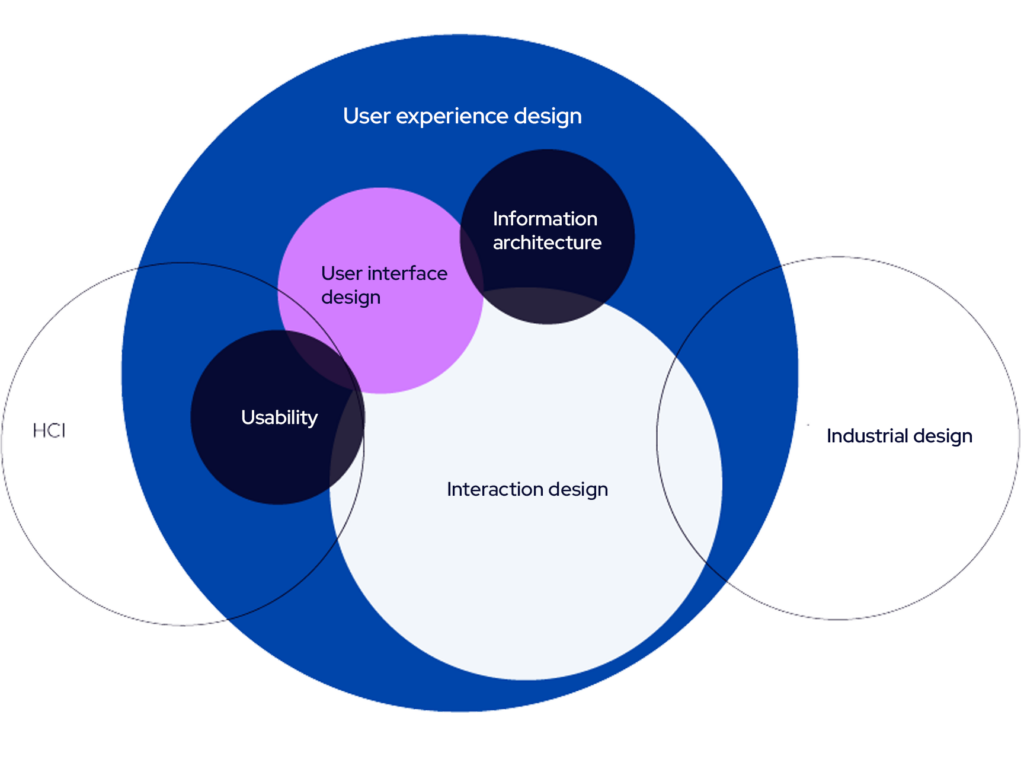
The user interface is, for example, the visible part of a website or application for the end user. Dan Saffer aptly describes the user interface in his book Designing for Interaction as the tip of the iceberg. What is visible on the surface is only a small part of a carefully designed whole.
Areas of user experience design, according to Saffer.
The user interface of a website or application is built from elements such as functionality, the layout of selected components in relation to one another and the screen size, colors, typography, and illustrations. The user experience, on the other hand, is shaped not only by the user interface but also by factors such as the accessibility, usefulness of the service/product, and how and from where the user arrives at the product/service.
User interface design is an important part of user experience design, as it is often the most visible aspect of the entire process. Visual design can, for example, support the detection of important elements in the correct order and help the user interpret the interface as intended. Perhaps due to the significance of interface design, it is sometimes confused with user experience design. However, it is essential to remember that the user interface is not the only part of the user experience. A good interface cannot save a poorly designed experience, but a bad interface can easily ruin an otherwise well-designed experience. The interface can be made visually impressive and distinctive, but usability, accessibility, discoverability, and other factors that impact the overall experience must not be overshadowed.
So, when considering purchasing UX design services, remember that the price tag should include more than just a visual update to the user interface. On the other hand, when purchasing UI design, you cannot expect to solve issues that require a deeper understanding of how the overall experience is shaped. A designer’s job is to question the needs presented by the client. An experienced designer, after familiarizing themselves with the case, will be able to advise on what would be the most beneficial course of action for that specific situation.
Sources:
Saffer, D. 2005. Designing for interaction: creating smart applications and clever devices. Berkeley, CA: New Riders
Sinkkonen, I.; Nuutila, E. & Törmä, S. 2009. Helppokäyttöisen verkkopalvelun suunnittelu. Helsinki: Tietosanoma
One of the most central and therefore also one of the most common questions related to software development in terms of investments is: “What does software development cost?” Naturally, this is one of the most critical factors when business decision-makers evaluate the current state and future needs of their digital systems.
Some of the most common challenges related to systems include the following situations:
digital services used by the company are entirely or partially outdated,
systems only partially meet the company’s business needs, or
existing digital systems do not support business scalability.
Digital services, such as web applications or mobile applications, are at their best key enablers for scaling a business and achieving related goals. When it comes to software development, delivering business value is always our top priority. We take it seriously that our clients receive genuine value from the systems we develop.
For us, business value means gaining a comprehensive understanding of the client, their needs, and the system to be developed even before starting the collaboration. Understanding the client, the problem to be solved, and the users of the product or service is therefore a crucial starting point for the partnership. This ensures that the product or service addresses a genuine need, which, in turn, is an essential foundation for making the investment.
In this article, we delve into the question of what software development costs. Since every company’s needs are unique and development is carried out through a wide variety of collaboration models, we cannot provide a very precise estimate of software development costs in this text. However, we aim to address this question at a high level and hope to have the opportunity to discuss your needs in more detail to provide a more accurate estimate of the project’s cost.
What factors influence the cost of software development?
The cost of software development is influenced by numerous factors. The most significant ones are the complexity of the work and the scope of the project, meaning how complex the system being developed is. This includes factors such as the number of features to be developed, the number of third-party backend systems involved, and various technological solutions. Other factors that affect the cost include the size of the team, the experience level of the developers, and the project timeline.
The size of the development team and the collaboration model
The size of the team, including software developers and UX designers, is naturally one of the key factors in pricing. The hourly rate for software development can range between 70 € and 150 €, depending on the consultant’s expertise. UX design typically has an hourly rate in the range of 80–100 €.
Another key factor influencing the cost is the collaboration model we choose as the foundation for our partnership.
If our client company has its own development team and needs extra hands or specific expertise, Identio’s software developer works as part of that team. This type of “additional resource” is an easy alternative to hiring a dedicated software developer. Additional resources are often needed when the in-house team lacks the technological expertise required for the project or when the project aims to prototype the suitability of new technologies for the client’s use. Other situations where consultants can be utilized include boosting efficiency as deadlines approach or ensuring continuity of development work during holiday periods. This is our most common collaboration model, and in such cases, hourly-based pricing often applies.
Additionally, we offer two different approaches where Identio’s own development team creates an entirely new system tailored to the client’s needs. The first approach involves close collaboration with the client, while the second is more of a turnkey solution. In the close collaboration model, we focus on transferring knowledge and skills to the client organization through coaching-oriented software development. In the turnkey solution, on the other hand, we develop a predefined product or service with a more independent approach, keeping the client’s role lighter. This model is well-suited for situations where the goals are clear, and the development team and client are aligned on the system to be developed.
Pricing for both of these models can be either hourly-based or fixed. In the case of fixed pricing, we agree with the client on a price range within which we commit to staying.
Other factors affecting the cost of software development
Several other factors also influence the costs of software development, and these should be considered when planning the project budget. The first key aspect to evaluate is the scope of the project. Are we building a lightweight MVP (Minimum Viable Product), an MLP (Minimum Lovable Product), or a more comprehensive software solution? Smaller projects are naturally more affordable, but the planning, implementation, and testing of larger systems require more resources.
The technologies and platforms used also affect costs: some technologies require specialized expertise, which can increase the project’s price tag. The team composition, tight deadlines, and post-launch maintenance and further development costs are other key variables that should not be overlooked when planning the budget. These factors together determine the appropriate budget to allocate for software development.
How to make software development cost-effective?
Cost-effectiveness in software development begins with a thorough definition phase. When a development project is carefully planned in advance, expensive changes in later stages can be avoided. A comprehensive requirements definition saves both time and money and helps the team focus on what is essential. Additionally, prioritizing the most important features is key, for example, through MVP (Minimum Viable Product) or MLP (Minimum Lovable Product) thinking. This means focusing in the early stages of the project on delivering a minimal yet lovable solution that addresses clearly defined needs.
Through agile development and iterative thinking, the development process can adapt quickly to changing needs and feedback from users. This approach helps allocate the budget to features and elements that are genuinely important from the users’ perspective.
Choosing the right team is also a critical factor in ensuring cost-effectiveness. A team with experience in similar projects can typically deliver high-quality results while managing the project efficiently and smoothly. Cost-effectiveness doesn’t always come from selecting the cheapest provider or partner but from professional work where things are done right from the start.
Well-executed software development delivers long-term value and, most importantly, supports the growth of your business. In contrast, cheap development done with insufficient expertise can ultimately result in costly repairs and rework.
Concrete pricing examples
It is challenging to discuss software development costs with absolute precision, but I hope these examples provide you with a general idea of the expenses involved in software development.
These examples are based on Identio’s pricing and apply to digital products and services tailored and developed to meet your needs, as well as the hourly billing rates of our consultants.
Tailored digital products and services, and consultants’ hourly rates
Medium-sized software: ~30 000–100 000 €
Comprehensive custom software: ~100 000 € +
Software development / IT consultant hourly rate: 80–120 €
UX designer’s hourly rate: starting from 85 €
Software development cost estimate
The cost of software development is highly case-specific, and we hope this article has provided you with indicative information about the scale of the investment. We look forward to discussing your specific needs and exploring what software development might cost in your unique situation.
Contact our sales team, and we’ll help you identify your company’s specific software development needs. Through discussion, we can jointly assess the scope of technical implementations and provide a rough estimate of development costs.
Identio as a technology company
Identio’s software developers specialize in consulting, which means we work closely with our clients throughout the entire process—from designing a digital product or service to its development and maintenance.
We design sustainable software architecture solutions and develop digital products and services with a focus on user-friendliness, scalability, and cost-efficiency. We are also here to assist you with updating and modernizing your existing systems.
Former Google Ventures design partner Jake Knapp developed the design sprint process for Google in 2010, drawing inspiration from Google’s own product development culture and IDEO’s design thinking workshops. In design sprints, teams work on problems and set goals, progressing from mapping out a product or service to testing a potential solution—typically within a five-day cycle.
Sprints are also a key part of agile development. The biggest benefit of a design sprint is the time it saves, as well as the insights gained during the process regarding the future product or service, its opportunities, and challenges. A design sprint provides a clear picture of the next steps in development and ensures that the team is aligned on the desired outcome.
The five phases of design sprint
A design sprint is divided into five phases, which are typically scheduled over one week, with each phase taking place on a different day. However, in some cases, the sprint can be adapted to a more flexible timeline, such as a two- or three-week development cycle.
The core idea of a design sprint is to quickly and efficiently gain a clear understanding of the product or service being developed. For this reason, it is generally not advisable to extend the sprint for too long. However, in some situations, deviating from the traditional one-week model may be justified.
1
Exploration
During the exploration phase, all essential information is shared within the team to ensure that all parties have a unified understanding of the project’s background and current state. This phase aims to identify and analyze pain points that hinder or slow down the achievement of goals. A thorough understanding of these pain points is crucial, as they guide future design and development decisions.
Additionally, in the exploration phase, the scope of the project is outlined to keep the work realistic within the given schedule and resource constraints.
Identio’s approach
Workshop #1 – In the first workshop, we go through the key aspects of the project together with the client. The discussion focuses particularly on the project’s objectives and technical foundations, ensuring that all stakeholders have a shared understanding of the goals and requirements.
2
Ideation
The second phase of the design sprint, ideation, is a creative stage where the team develops potential solutions to improve the product or service. The goal is to address the key questions and challenges identified during the exploration phase.
In the ideation phase, the focus is particularly on solving the identified pain points with new perspectives and approaches. The team considers how these pain points can be resolved while taking into account technical feasibility and user experience.
By the end of the ideation phase, the team has multiple options that will be evaluated in the next stage.
Identio’s approach
Workshop #2 – In the second workshop, we brainstorm alternatives together with the client for the questions that emerged during the exploration phase. We also present our technology proposal for implementing the product or service.
3
Decision-making
In the decision-making phase, the team focuses on selecting the best ideas to move forward to the prototyping stage. Various tools, such as the Sticky Decision method, are often used to facilitate the decision-making process.
After the decision-making process, a storyboard is created to visualize the flow of the selected ideas. The storyboard helps assess whether all chosen ideas fit into a single prototype. By using the storyboard, the team can outline the user experience of the product or service and ensure that the selected ideas form a cohesive and functional whole.
Identio’s approach
Workshop #3 –In the third workshop, we prioritize and define the scope of the interactive demos to be implemented in the Prototyping phase. Methods such as Planning poker can be used to support the process.
4
Prototypes
The fourth phase of the design sprint, prototypes, focuses on creating concrete models based on the ideas selected during the decision-making phase. The team can create one or multiple prototypes representing different solutions and approaches.
During the prototyping phase, an interactive demo is developed to allow users to experience the product or service. This demo serves as a crucial tool in the next phase, where it will be tested. The prototype should be realistic enough to provide an authentic experience, but it does not need to be perfect or include all final features. The most important aspect is that the prototype illustrates the key ideas and enables practical testing.
Identio’s approach
We build an interactive demo using the Figma tool. With the prototype, we discuss potential gaps and areas for improvement with the client before testing.
5
Testing
The purpose of testing is to gather valuable feedback on how well the prototype meets user needs and expectations. This phase also helps identify potential problem areas and gaps in the user experience before the actual product development.
The feedback collected during testing is reviewed, and necessary adjustments are made to avoid unnecessary work in the final product development.
Identio’s approach
We test the prototype together with the client. We document the observations from the testing and discuss the next steps before starting the development of the product or service.
Supporting development with a design sprint
A design sprint helps quickly gain an overall understanding of the state of the product or service before starting actual development.
Potential benefits of a design sprint include:
The goals and pain points of the product or service have been mapped out, and the development team is aligned on the product or service being developed.
The ideas from the ideation workshop have been documented, reviewed, and prioritized.
A preliminary assessment and proposal for technology choices have been made.
An interactive demo of the product or service has been built, helping to visualize the desired outcome.
Through testing, areas for improvement have been documented.
The actual development of the product or service can begin.
During a design sprint, the team maps out goals and challenges, generates solution ideas, selects the best ones, builds a prototype, and tests it in practice. This process helps avoid potential pitfalls before starting actual development and ensures that the team is working toward a shared goal.
What is something that not everyone knows about you?
I might be more empathetic than the average person, and I have the ability to understand other people, their situation and their feelings. I see it as my strength. I have realised that it must be one reason for me to be interested in user experience design that goes deeper than the surface.
I want to believe that being empathetic makes me a better designer. Empathy also affects my skill to doubt instead of believing that everyone must think and act in a certain way. Sometimes I wonder if I’m too sensitive or empathetic. I have also understood how helpful it may be.
What was the spark that inspired you to join Identio?
I was applying for another traineeship position, and I had two choices. One was the office where I had completed my first traineeship, and the other was Identio, whose recruiting notice I found in a marketing students’ Facebook group.
I was interested in Identio because I had already noticed their great spirit through social media. I’m not ashamed to say that I was also attracted by the great number of young people working at Identio.
What drives you in your work?
The whole world of UI/UX is fairly new, especially in Finland. I’d like to guide the field in the right direction by doing my part. I’d like it to be seen as a whole and not as “sugar-coating things”. It would be great if people would associate for example research with the term right away. UI/UX design is more like a scientific field of its own. It involves different roles and designing may be a long and comprehensive process.
I’d also like to become a known designer in Finland someday. It would be great if someone would recognise my name.
What would you like to tell your future colleague?
Lately, I have been working on how important it is to tolerate mistakes. I am a perfectionist and I have learned, that tolerating incompleteness and mistakes is the only way to grow as a person and as a professional.
I would advise you to embrace mistakes and be merciful to yourself.
Are you interested in Identio as a workplace? See our open positions.